 Prosit Paul
 Chief Operating Officer
- NIHT 07 May, 2026
Listen to this blog

Artificial Intelligence is changing digital marketing faster than any shift the industry has seen in the past decade.
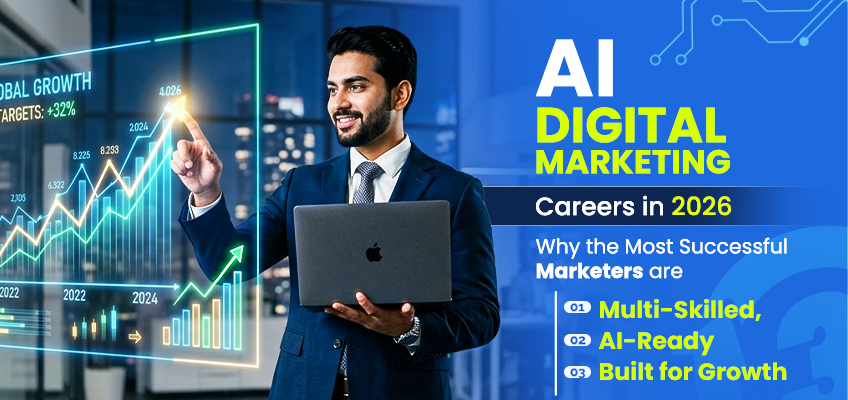
If you are exploring digital marketing careers in 2026, especially in India, understanding how AI is reshaping roles is critical before choosing the right learning path.
From automated ad optimisation and AI-generated content to predictive analytics and smart customer segmentation, AI is now embedded into modern marketing workflows.
Naturally, many students and aspiring professionals are asking:
Will AI reduce digital marketing jobs or create new opportunities?
The evidence suggests the latter.
AI is not eliminating digital marketing careers. It is redefining them.
In fact, as businesses adopt AI across marketing functions, demand is rising for professionals who can combine digital marketing expertise with AI fluency, strategic thinking, and cross-functional execution.
For students planning their careers in 2026 and beyond, this presents a major opportunity.
AI Is Reshaping Marketing, Not Replacing Marketers
According to McKinsey & Company, marketing and sales remain among the business functions seeing the highest adoption of generative AI across organizations.
As per McKinsey & Company’s latest research as of early 2026, generative AI (gen AI) adoption has skyrocketed, and marketing and sales remain among the top business functions implementing these technologies.
Key findings regarding generative AI in marketing and sales include:
Adoption Milestone: Over 70% of organisations now regularly use gen AI in at least one business function, with the biggest increases observed in marketing and sales.
Top Functional Use: Marketing and sales, along with product development and IT, are the areas with the highest and most frequent deployment of generative AI.
High Value Potential: Marketing and sales are estimated to reap roughly 75% of the total value that generative AI could contribute to global productivity, according to McKinsey's analysis.
Specific Marketing Benefits: Gen AI is frequently used for personalized marketing (8% adoption), creating images/videos (8%), and first drafts of text (9% adoption).
Sales Impact: AI tools applied to sales can increase leads by up to 50% and cut customer acquisition costs by up to 60%.
Future Growth: As of early 2026, 90% of commercial leaders expect to utilize gen AI solutions "often" within the next two years.
While adoption is high, many organisations are still experimenting (62%) and have not yet fully scaled AI across their enterprises, with marketing often serving as a primary testing ground.
Businesses are increasingly using AI to support:
Paid advertising optimisation
Content ideation and drafting
Predictive audience segmentation
CRM automation
Campaign analytics and forecasting
Creative production workflows
At the same time, global digital advertising investment continues to grow year after year, reinforcing that businesses remain committed to digital acquisition and online growth.
Key takeaway:
AI is not reducing the importance of marketing. It is increasing the demand for smarter, more capable marketers.
What Companies Now Want to Hire
The hiring market has evolved significantly.
Employers are no longer only searching for candidates who can perform isolated platform tasks like:
Running Meta Ads
Writing SEO blogs
Managing Instagram pages
Scheduling email campaigns
Those skills still matter. But by themselves, they are no longer enough.
Employers Increasingly Prefer Marketers Who Can Think Across Functions
Businesses now favor professionals who can contribute beyond one narrow specialization.
Examples include:
A performance marketer who understands landing page conversion
An SEO strategist who can leverage AI content systems
A social media marketer who understands paid amplification and analytics
A CRM specialist who can connect retention with acquisition insights
This is because leaner, faster-growing companies want talent that can solve broader business problems.
The Strongest Growth Careers in AI Digital Marketing
If you are evaluating the future of digital marketing jobs, these roles currently show some of the strongest long-term relevance.
Performance Marketing Specialist
Focuses on:
Paid ad campaigns
Budget optimisation
Lead generation
Return on ad spend improvement
Why demand remains high:
Paid acquisition continues to be a major revenue engine for many businesses.
SEO and Content Strategist
Focuses on:
Organic traffic growth
Search intent mapping
Content planning
Authority building
Why demand remains high:
As AI increases content volume, strategic SEO becomes more important.
Marketing Automation and CRM Specialist
Focuses on:
Lifecycle marketing
Email automation
Retention workflows
Lead nurturing systems
Why demand remains high:
Retention and LTV are increasingly critical for business profitability.
Conversion Rate Optimisation Specialist
Focuses on:
Funnel optimisation
Landing page performance
User behavior analysis
A/B testing
Why demand remains high:
Traffic costs are rising, making conversion efficiency more valuable.
Growth Marketing Manager
Focuses on:
Cross-channel growth strategy
Experimentation
Funnel performance
Revenue-driven marketing initiatives
Why demand remains high:
Companies increasingly want marketers tied directly to growth outcomes.
Why Single-Skill Marketers May Struggle
AI tools are rapidly automating repetitive execution tasks such as:
Basic ad setup
Routine reporting
First-draft content writing
Design variations
Bid optimization
Data summarisation
This means professionals who only know how to execute one narrow task may face increasing competition and slower career progression.
The market is moving away from platform operators.
It is moving toward strategic operators.
The Power of 3: Why Multi-Skilled Marketers Have an Edge
One of the most practical ways to future-proof your career is by building expertise across three complementary skill areas instead of relying on one isolated specialisation.
This is the Power of 3 approach.
Why It Works
Because modern marketing is interconnected.
A marketer who understands only ads may miss conversion issues.
A content creator without SEO may struggle to drive reach.
A social media specialist without analytics may struggle to improve results.
Example Multi-Skill Combinations
Growth Performance Path
Performance Marketing
Analytics
Conversion Optimization
Organic Growth Path
SEO
Content Strategy
AI Content Systems
Creative Growth Path
Social Media Marketing
Paid Advertising
Creative Strategy
Marketers who build this broader capability often benefit from:
Better hiring opportunities
Faster promotions
Higher salary growth
Stronger adaptability across industries
Why Training Must Evolve With the Industry
Many digital marketing courses still teach fragmented, outdated modules focused heavily on tools.
But the industry no longer rewards tool knowledge alone.
It rewards:
Strategic understanding
Cross-functional capability
AI-enabled execution
Practical business application
That is why students increasingly need training programs built for the future of marketing, not the past.
Building a Future-Ready Career With the Right Foundation
At NIHT, the focus is on preparing students for where the market is heading, not where it has been.
The NIHT Master Program is designed around the realities of modern hiring by helping learners build:
Multi-domain digital marketing capability
AI-integrated workflow understanding
Strategic marketing foundations
Practical campaign execution skills
Industry-ready portfolio experience
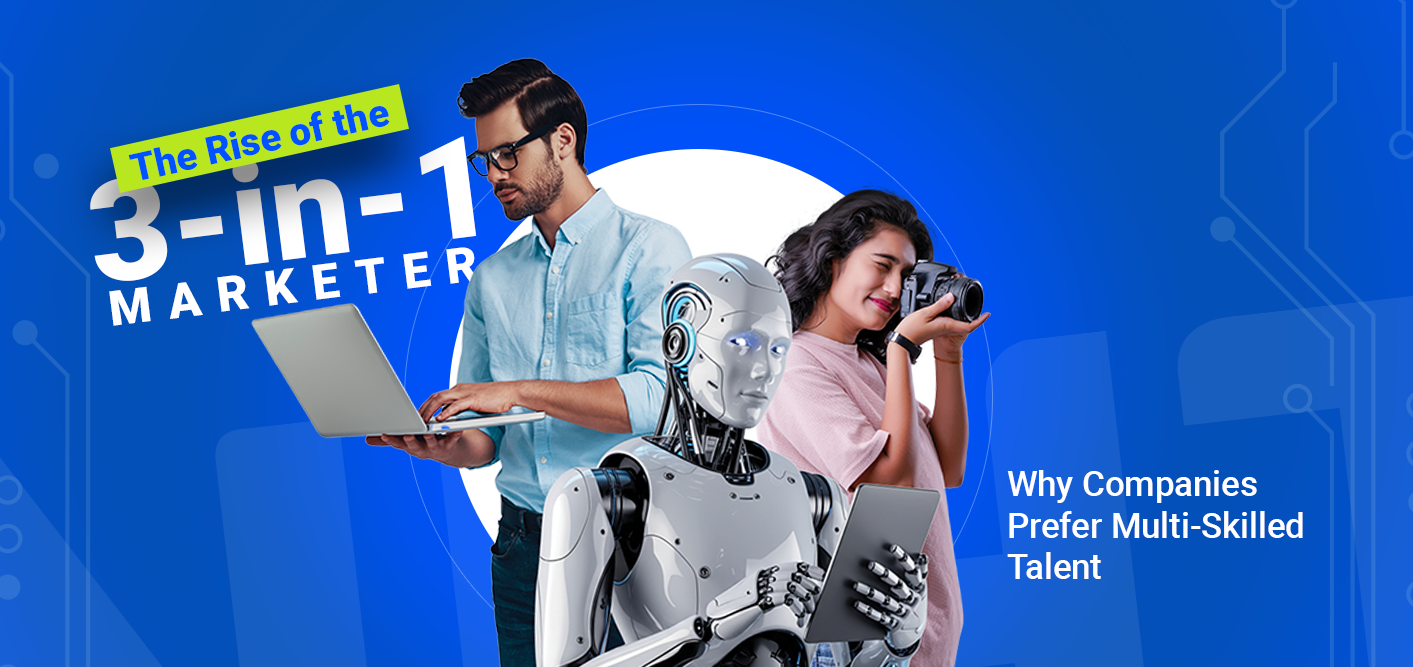
Its structure reflects the same market shift driving employer demand: the rise of the multi skilled marketer.
Rather than training students for a single platform, the goal is to help them build the broader capability needed to thrive in an AI-driven marketing environment.
At NIHT, the focus is on preparing students for where the market is heading, not where it has been.
With a 93% placement rate, 350+ hiring partners and 100% job assistance, along with structured practical exposure, capstone projects and portfolio development, the emphasis is on building real capability rather than just theoretical knowledge.
The future belongs to multi-skilled marketers who can create, market and automate effectively.
Final Thoughts
Digital marketing remains one of the strongest career opportunities for students entering the workforce, but success in the field now requires a different mindset.
The future does not belong to marketers who only learn one tool or one platform.
It belongs to those who can:
Think strategically
Execute across functions
Work effectively with AI
Drive measurable business growth
In 2026 and beyond, the most valuable professionals will not simply be digital marketers.
They will be multi-skilled, AI-enabled growth marketers.
If you want to build a career that stays relevant as the industry evolves, the smartest step is to start building that capability now.
Start Building the Skills that the Future Demands
The marketing industry is evolving quickly.
Your learning path should evolve with it.
Explore the NIHT Master Program and build the multi-skill, AI-ready foundation employers increasingly look for in modern marketers.
Because the future will not reward average marketers.
It will reward adaptable growth creators.


.jpeg)